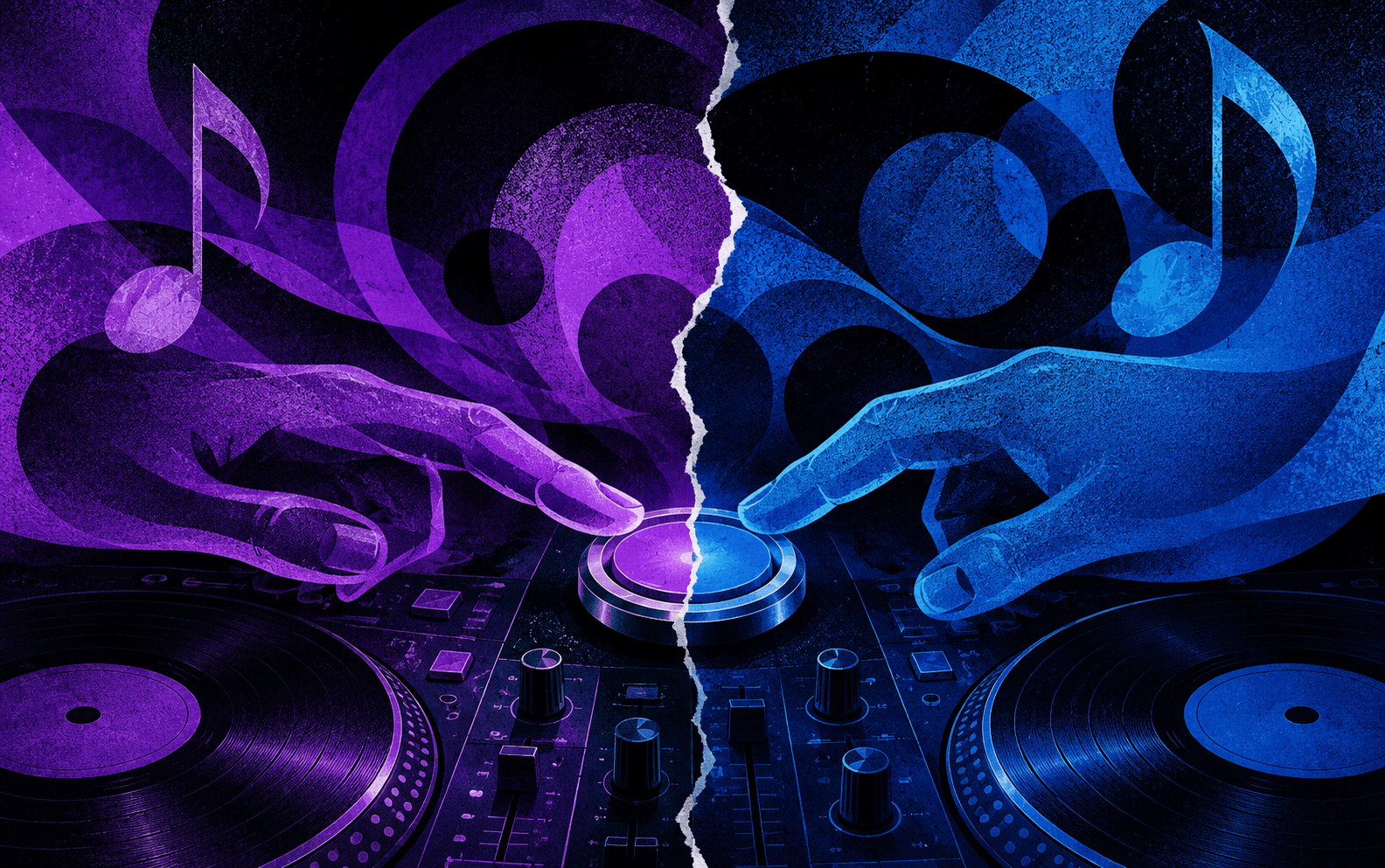

Why a Feature Designed to Help DJs Became the Most Controversial Button in DJing
I’ve spent years documenting dance floors. This time, I’m documenting myself.
Most Techno & Pizza posts are event recaps, photos from a weekend, a set that moved us, a sunrise we didn’t plan for. This one’s different. It’s about music. It’s about technology. It’s about ego. It’s about why a feature designed to help DJs became the most controversial button in DJing.
And maybe it’s also about me.
The Tape-Trading Kid from the 90s
Long before I learned to DJ, I was collecting music. I was the kid filling my suitcase with cassette tapes before trips to Iran and returning home with whatever I could find there. Sometimes it was old Persian classics. Sometimes it was contemporary Iranian pop, the kind of government-approved music sold in stores and on street corners. The kind that was everywhere in Iran and nearly impossible to find in the U.S.
And sometimes I made my own. I was maybe ten years old when I learned you could stuff paper towels into the tabs on top of a cassette tape so you could record over it again. So I did, over and over. I’d sit by the radio waiting for my favorite songs to come on, finger hovering over the record button, hoping the DJ wouldn’t talk too much and trying to time it perfectly.
Sometimes I’d miss the intro. Didn’t matter. I’d wait for the song to come around again. I wasn’t just collecting music. I was chasing it. I just didn’t know it yet.
From IRC Channels to Internet Meetups
That instinct never left. It evolved from tapes to CDs, to Napster, to LimeWire, to IRC, to MySpace, to USB sticks.
Yes, IRC. I was an admin in an IRC channel called #music. And no, they didn’t just hand those out. You had to spend an embarrassing amount of time in the channel. People had to trust you. There was an actual vote. Which means somewhere out there were dozens of strangers who collectively decided, “Yeah. This little girl is obsessed with music enough to be in charge.” Honestly? They were right.
I know. I just dated myself. I spent countless hours talking to strangers about songs, trading recommendations, downloading things at painfully slow speeds, and searching for music I didn’t even know existed yet. And yes, MySpace, where choosing the perfect profile song felt weirdly important. I spent an embarrassing amount of time curating mine. If you didn’t spend an hour choosing your profile song, were you even there?
I was twelve years old and somehow convinced my parents to let me go to a music meetup with people from the Internet. This was the nineties, long before meeting up with Internet strangers was normalized. Can you even imagine that now? An underage girl going to hang out with a bunch of forty-year-olds just to talk about music.
My friend and I were the only underage girls there. And in retrospect… what on earth were we thinking? How did my parents even allow it? I can’t even remember if they knew we went. It’s honestly a miracle I’m here writing this article instead of starring in a cautionary documentary about Internet safety.
Then there was college. I’d take trips to New York and come back with stacks of mixtape CDs. Dancehall. Reggae. Hip-hop. Questionable remixes. Let’s not even start.
The Piano Teacher Was Right
Music was everywhere in my family. My mom sings. My dad dabbles. My brother has a genuinely beautiful voice. And me? I tried a little bit of everything. I sang in chorus. I took flute lessons for maybe a month and could barely get a sound to come out of the thing. I think I lasted four or five clarinet lessons before deciding it wasn’t for me.
But piano stuck. Or maybe I stuck with piano. The funny thing was that I could play by ear almost immediately, which fascinated my parents and drove my piano teacher slightly insane. Every lesson he’d remind me, “She needs to read the notes.” And every lesson I’d nod politely and continue doing whatever I wanted. Sometimes I’d even pretend to read the sheet music while secretly playing by ear. I was convinced I was fooling him. I was not.
At some point, he sat my parents down and explained that I couldn’t just rely on my ears forever. He was right, of course. Eventually, I learned to read music. And then I promptly forgot most of it.
Do I know music theory? Honestly, not in the academic sense. I couldn’t tell you all the rules. But I know when something sounds wrong. I know when two melodies are fighting each other. I know when tension needs release. I know when a room wants energy and when it needs a breather. I know how music makes me feel.
Forced Into My True Calling
DJing came much later. I actually had a piano on my Christmas list so I could get back into playing, but Salar, my partner, had other plans. He bought me CDJs, speakers, and monitors, and told me I needed to learn. He basically forced me into it, so huge shout-out to him.
From there, I learned bits and pieces from my OG crew, the people who paved the way for me. Shout out to Shawhin, Eiman, Ali, and Ace for those lessons in the booth, and I taught myself the rest. My education was messy: house parties, B2Bs, club booths, mistakes, and lots of trial and error.
And honestly, that’s probably why the sync debate fascinates me so much. Because outside of DJing, nobody argues like this.
- Nobody tells photographers they’re cheating because autofocus exists.
- Nobody tells software engineers they’re cheating because they use automated tooling or AI to write foundational code.
- Nobody tells architects to throw away CAD and go back to pencil and paper.
- Nobody tells drivers they’re cheating because they drive an automatic instead of a stick shift…actually, wait. Yes, they do. Bad example. Car guys will absolutely lecture you about the purity of three pedals. Never mind. Let’s stick to the other examples.
Technology changes the mechanics of a craft. It doesn’t eliminate the craft.
And DJing has embraced technology at every step. Vinyl DJs mocked CDs. CDJs mocked controllers. People complained about waveforms, then hot cues, then key detection, then stems, and now sync. The funny part is that most of the people complaining about sync are already using technology that would’ve been considered cheating twenty years ago:
- You use Rekordbox to analyze tracks.
- You use quantize for your loops.
- You use hot cues and beat grids.
- You read visual waveforms and sort by BPM.
- You bring thousands of songs on a USB instead of carrying crates.
Congratulations. You’re a technology enthusiast. So am I.
A Massive Dose of Humility
And yes, I use sync. Most of the time. Not because I can’t beatmatch by ear. I can. I know how. Maybe I can’t do it as fast as you.
I bought turntables recently. No waveforms. No sync. No quantize. No grids. Just my ears and a whole lot of humbling experiences. And wow, it’s really hard. To be completely honest, I kind of suck at it right now. I’m okay, I guess, but it has given me a massive dose of humility and so much respect for people who do it well. I’m getting better, but I’m definitely not there yet.
But let me tell you, the lengths people will go to to justify their hate for this button is wild. A friend recently told me that a famous DJ claimed that using sync makes the track sound worse and actually degrades the audio quality. What a crock of shit. I have even seen DJs and producers making online content claiming that sync actively destroys audio quality, people whose music I otherwise love, buy, and deeply respect. It is pure pseudoscience masquerading as elite technical knowledge, and honestly, it sounds incredibly dumb.
The Real Sound Science (Fake Physics Need Not Apply)
If we want to talk about actual sound quality, any audio engineer in the room will tell you degradation happens all across the signal chain. It’s bad gain staging that pushes channels into the red, clipping amps, overdriving speakers, low bitrate 128kbps rips, poor system tuning, and ignoring room acoustics that usually do the most damage.
Meanwhile, sync is just BPM and phase matching. That’s metadata. It doesn’t magically degrade audio quality. Master Tempo can introduce artifacts at extreme tempo changes, sure, but pretending it’s the reason a set sounds bad while the mixer is clipping is missing the point entirely.
If you want to hate sync, go for it. If you think learning without sync makes you a better DJ, that’s a perfectly reasonable opinion. But inventing fake audio physics to justify your ego is weird.
The funniest part is watching people complain about sync ruining the purity of DJing while they’re redlining the mixer, playing 128kbps files they downloaded from 20 years ago, standing in a room with acoustics that sound like a parking garage, and wondering why they just completely cleared the dance floor.
Honestly, give me a break. There are literally social media accounts entirely dedicated to filming other DJs’ hands just to call them out for using sync. Imagine having that much time on your hands while nobody is dancing to your music.
“Come On, Bro” — Real-Time Performance Reality
And honestly? Sometimes I get nervous. I know how to beatmatch, but when the pressure is on, and the clock is ticking, and somebody is hovering over me waiting for me to mess up… yeah, I get in my head. I rush. I second-guess myself. I’m human.
So maybe stop making me nervous. Or better yet, cheer me on.
If you see me struggling with a track that you know is notoriously brutal to mix, just jump in and mix it out for me. I promise I will do the exact same for you. We can always stay up late, fuck around, and mess around on the decks later, but if we are actively performing in front of a crowd, come on, bro.
Throw me a cool track. Help me discover something. Show me a trick. Tell me about a producer I should know. I promise I’ll return the favor. Because that’s the culture I want to be part of.
Freedom Beyond the Tempo Slider
I’m a perfectionist. I spend countless hours on Rekordbox making sure my grids are perfectly aligned. I zoom in embarrassingly far. I fix tracks that analyze incorrectly, replace low-quality files, and obsess over making sure the audio sounds great.
People talk about sync like it is an automated autopilot, but it only works beautifully if you do the grueling groundwork at home first. I’ve just swapped the time spent manually nudging a jog wheel in the booth for hours of meticulous preparation behind a laptop screen.
Because my hands and my brain aren’t constantly occupied with managing a drifting tempo slider, I am mentally free to think three steps ahead. I obsess over phrasing. I set complex hot cues. I read EP descriptions and interviews because I want to know what inspired a track. I discover a new producer and suddenly I’m three releases deep into their catalog. Then I follow them, follow the label, and somehow discover five more emerging artists along the way. This isn’t homework. I genuinely love it.
I love using hot cues to jump around, skipping a breakdown, repeating a vocal, extending the best sixteen bars, or looping a groove that deserves another minute. The automated sync grid gives me the cognitive freedom to treat the decks like a sampler rather than just a playback machine.
Sometimes the version I play doesn’t even exist. I steal the intro from one section, skip ahead, loop something unexpected, jump to the outro, and build my own arrangement on the fly. Maybe that’s not how the producer intended it. But that’s kind of the point. I’m not trying to preserve music in a museum. I’m trying to make people dance.
A Club Booth Is Not a Tournament
And honestly? As I’ve started playing out more, I keep running into this weird energy and I don’t understand it.
I want to be clear: I play B2B with a lot of people, and this piece isn’t about anyone in particular. I am not trying to offend anyone or point fingers. Sometimes it isn’t even a B2B partner; it’s the DJ playing right before you or right after you. In fact, it isn’t just my own experience. It is a collective vibe that comes up constantly in conversations with friends, comments on the Internet, and passing discussions in club corridors. It is everywhere.
Is this really the culture we want? What are we actually doing here? Why are we hovering over each other waiting for someone to mess up? I’ve had DJs throw me curveball tracks with drifting tempos and messy beat grids, then throw shade because I’m using sync during my own set.
What are we doing here? Are we trying to make great music together? Or are we trying to win? Because I’m not interested in winning. I’m not here to impress other DJs. I’m here to make people dance.
If you are so deeply obsessed with rigid technique and competition, go sign up for a DJ scratch contest or a technical mixing competition. Go enter the DMCs. Those spaces exist exactly for that kind of hyper-specific athletic grading, and they are incredible at what they do. But a club booth during a peak-time set is not a tournament. If you’re bringing that combat mindset into a standard club set, you’re missing the point of the room entirely.
Purity Tests and Unsolicited Lectures
And somehow, it’s always framed as helping.
- “I got your back.”
- “You should learn without it.”
- “If you ever play in Berlin…”
- “If you ever play with the Big Dawgs…”
- “You’re too good to use sync.”
- “Your level is too high to use sync now.”
- “You need to turn it off.”
I’ve heard it all. And honestly? I know people usually mean well. But it’s such a weird assumption that I haven’t thought this through. Are you trying to say you’re a better DJ than me? That you know music more than me?
Because my entire life is music. I promise you I have thought this through. I’ve spent years building my own workflow. I know what I like. I know what I value. And manually beatmatching every track just isn’t one of them. Sorry.
If your workflow is different than mine, that’s cool. Mine is different too. There are a hundred ways to get somewhere beautiful. This isn’t a purity test. It’s music. And after hearing the same lecture for the hundredth time, I have to ask: Are we making this more fun? Or are we just making sure everybody suffers the same way we did?
Generosity Over Combat
If you know your track is drifting, don’t just stand behind me and smirk. Tell me. If your beat grid is off, tell me. Help me out, and I’ll help you out too. Why are we acting like we’re guarding state secrets? Go spend time on downloading and looking for music instead. We’re standing next to each other trying to keep the room moving.
When I play B2B, I want us to sound as smooth as possible. I try to match keys when it makes sense. I ask before changing the vibe too dramatically. I try to leave room for the other person. I want us both to shine. I want us both to look good. I even have hot cues setup so my b2b partner has fun with my tracks.
I want the crowd to walk away thinking, “Damn. That was fun.” Not, “Wow. DJ A totally destroyed DJ B.” Who cares? A B2B shouldn’t feel like combat. It shouldn’t feel like an exam. It should feel like trust. Like generosity. Like a couple of music nerds getting excited and building something together.
What Are We Actually Chasing?
That’s the culture I want. Not one where we guard secrets. Not one where we hover over each other waiting for mistakes. Not one where we throw curveballs and call it mentorship. Help each other out. Share tricks. Share excitement. There’s enough music for all of us.
Beatmatching is not DJing. It’s a skill within DJing. An important one? Yes. A foundational one? Sure. But it is not the art itself.
The audience does not go home saying, “Wow, she manually nudged that jog wheel.” They go home saying, “That set made me feel something.”
And honestly? That’s the only thing I’ve ever been chasing. If we can trade the gatekeeping for community, and the judgment for actual connection, we might just remember why we all fell in love with the dance floor in the first place.
In the next article, we are going to dive deep into the unwritten rules of the booth. Stay tuned for a complete guide to B2B etiquette.
 Techno & Pizza